
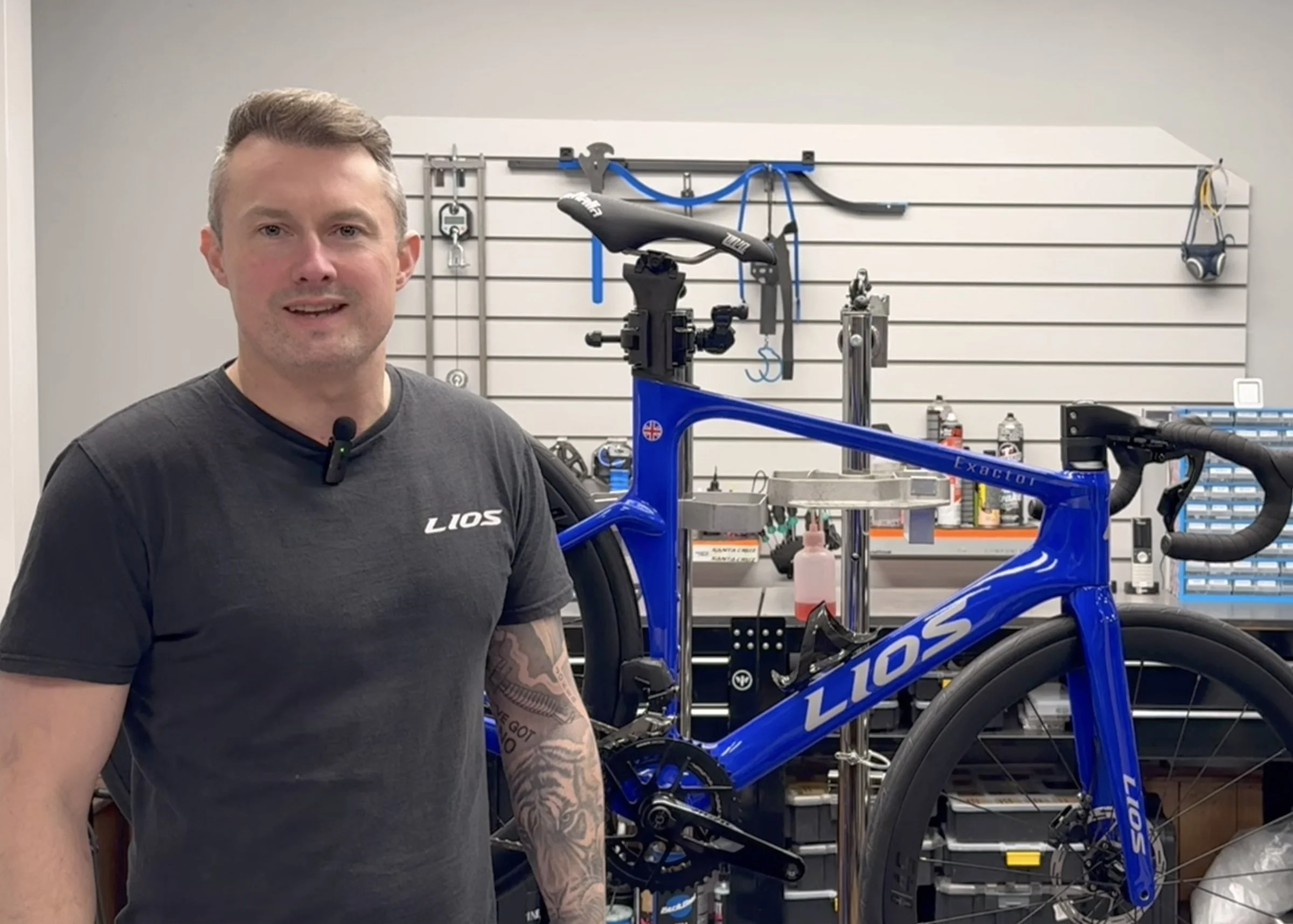
Bibi Abernethy’s LIOS build configured for British Triathlon’s 7.00m rollout regulations using SRAM Rival E1 AXS
British Triathlon introduced a universal 7.00 metre rollout limit for Youth draft legal racing from the 2026 season onwards.
For many athletes this is straightforward. Most examples referenced in the regulations are based around Shimano gearing, such as 36×11T.
However, a growing number of bikes now use SRAM AXS electronic groupsets, which use a 10 tooth smallest sprocket. This changes the gearing architecture and can create confusion when trying to ensure a bike complies with the regulations.
Recently we built a bike for Bibi Abernethy, a Youth athlete competing in the British Triathlon Super Series and needed to make sure the setup complied with the 7.00m rollout rule.
This article explains exactly what we did, why it works within the regulations and how rollout should be measured correctly.
A full video walkthrough of the process is included below.
The British Triathlon Rollout Rule
British Triathlon restricts gearing for younger athletes by measuring rollout distance.
You can read the official regulation here:
https://www.britishtriathlon.org/gear-restrictions
Rollout is defined as the distance a bike travels during one full crank revolution in its hardest available gear.
From the 2026 season onwards the maximum permitted rollout is:
7.00 metres
The aim of the rule is to:
Encourage better race dynamics.
Prevent excessive gearing for younger athletes.
Maintain fairness across the field.
British Triathlon also emphasises that rollout must be physically measured, as wheel and tyre combinations influence the result.
Why SRAM AXS Creates a Different Challenge
Many examples published in rollout guidance assume Shimano style gearing where the smallest cassette sprocket is 11 teeth.
Typical examples include:
36 × 11
46 × 14
52 × 16
However SRAM AXS road groupsets typically use a 10 tooth smallest sprocket.
For example:
48 × 10
This gear would produce a rollout significantly above 7.00 metres and clearly fail the regulation.
At the same time British Triathlon advises that electronic derailleurs should not be restricted using limit screws, as this can damage the servo motors.
You can read the electronic gearing guidance here:
https://www.britishtriathlon.org/britain/documents/events/gear-res/25.electronic-gears.pdf
So any solution must:
Avoid restricting the rear derailleur.
Work with electronic drivetrain systems.
Produce a rollout below 7.00 metres.
The Bike Specification
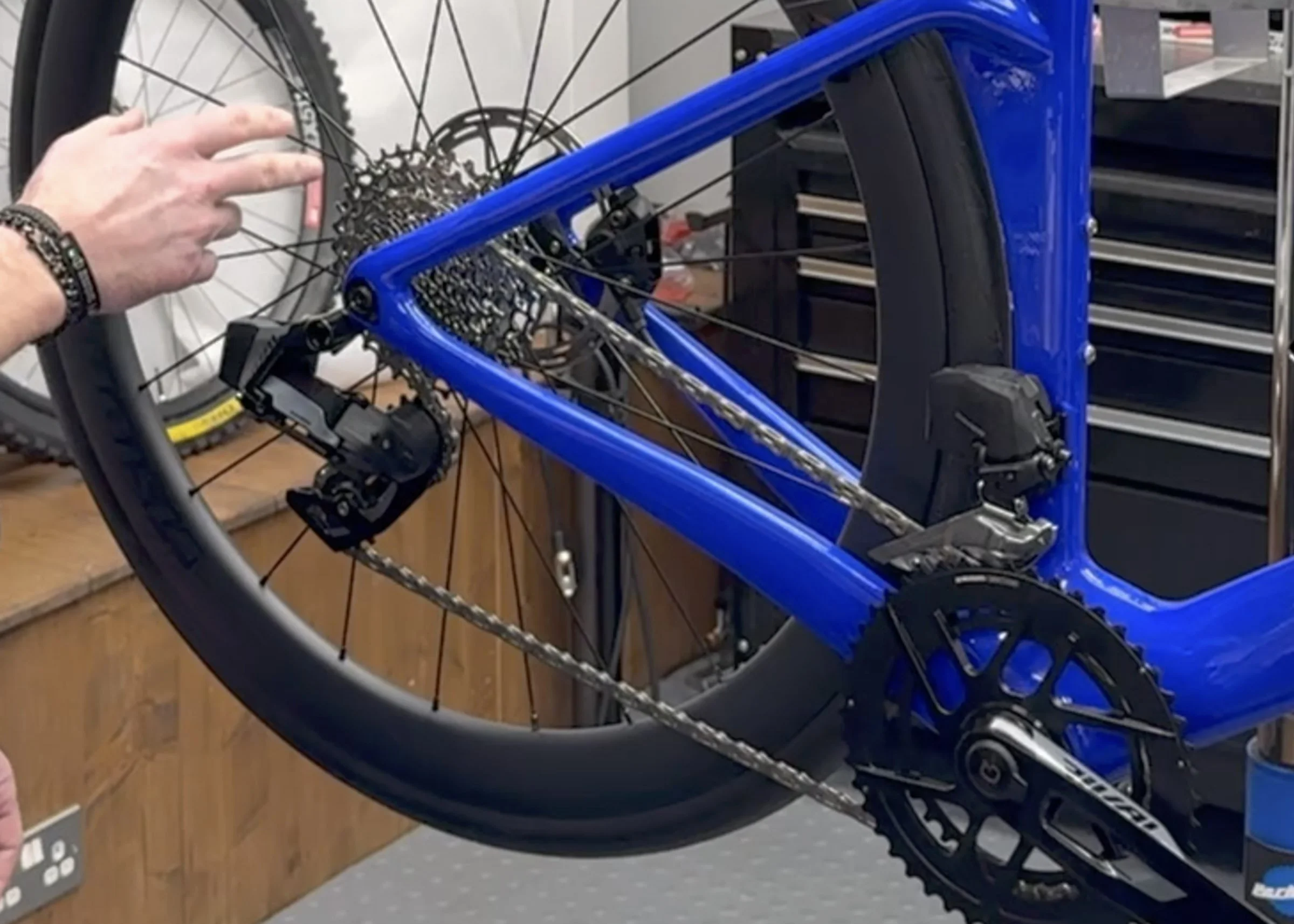
The bike was built using SRAM Rival E1 AXS with 48/35T chainrings and a 10-36T cassette
The bike was built with the following components:
Groupset: SRAM Rival E1 AXS 2×
Chainrings: 48/35T
Cassette: 10-36T
Wheelset: Vision SC 45 SL i23 Disc (internal Rim Width of 23mm)
Tyres: Goodyear Eagle F1 R (700x30)
Tyre Pressure During Test: 75PSI
Modern wheelsets with wider internal rim widths increase tyre volume and therefore wheel circumference. This is one of the reasons rollout must always be tested physically rather than relying on calculations.
British Triathlon conducted an audit of Youth athletes at the 2025 Performance Assessments, analysing tyre widths and gear combinations used across the pathway.
That document can be read here:
Compliance Method for SRAM AXS
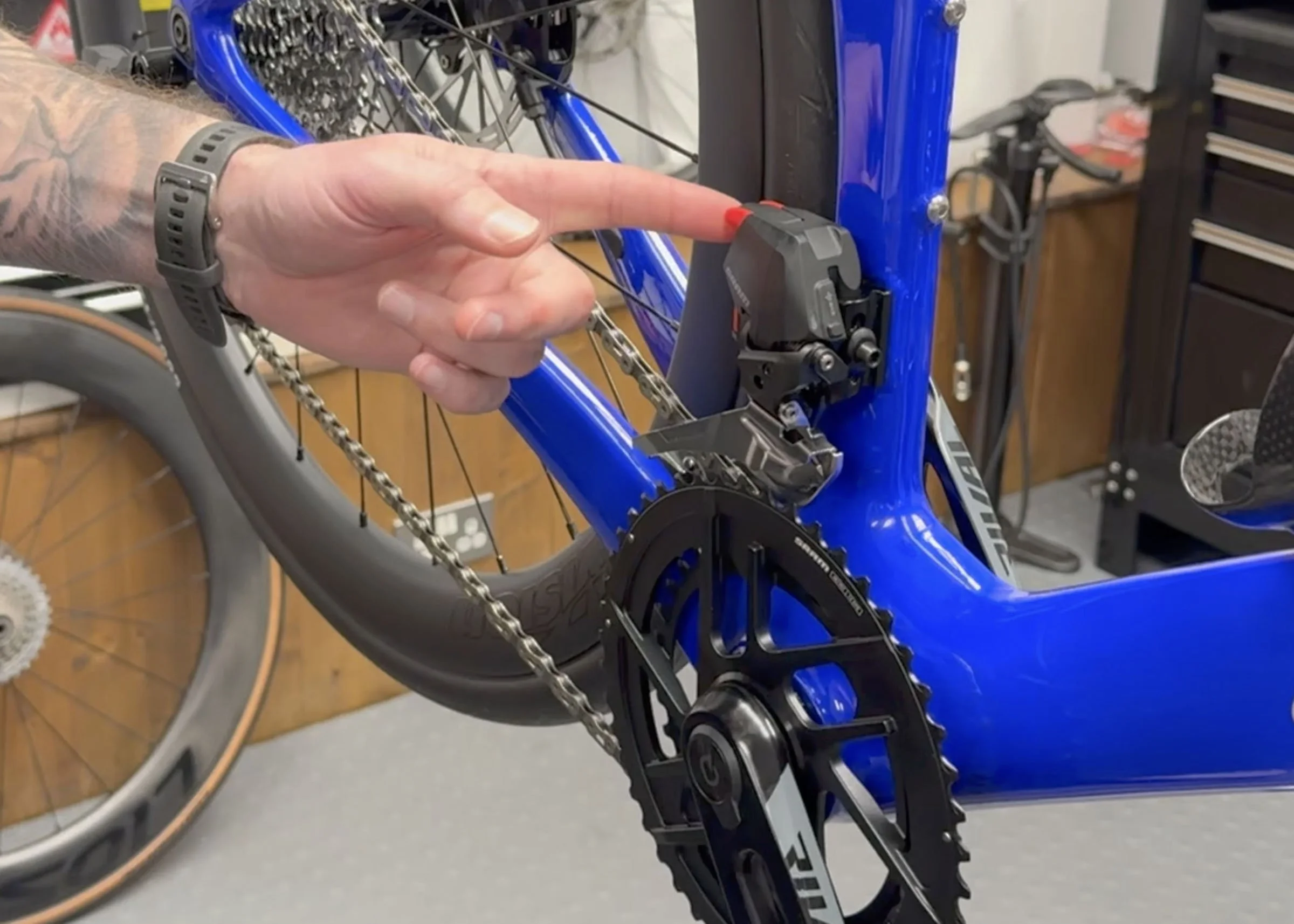
Removing the front derailleur battery locks the drivetrain onto the 35T chainring without restricting the rear derailleur
The method we used relies on a feature referenced in the British Triathlon electronic gearing guidance.
Instead of restricting gears mechanically, the front derailleur battery can be removed.
The process is straightforward.
Shift the chain onto the 35T small chainring.
Remove the front derailleur battery.
The front derailleur becomes inoperable.
This locks the drivetrain onto the 35T chainring.
Importantly:
The rear derailleur remains unrestricted, although the AXS system does not allow it to go into the bottom 10T sprocket.
No limit screws are adjusted.
The electronic system is not forced against a stop.
This approach follows the intent of the British Triathlon electronic gearing guidance.
What Happens at the Cassette
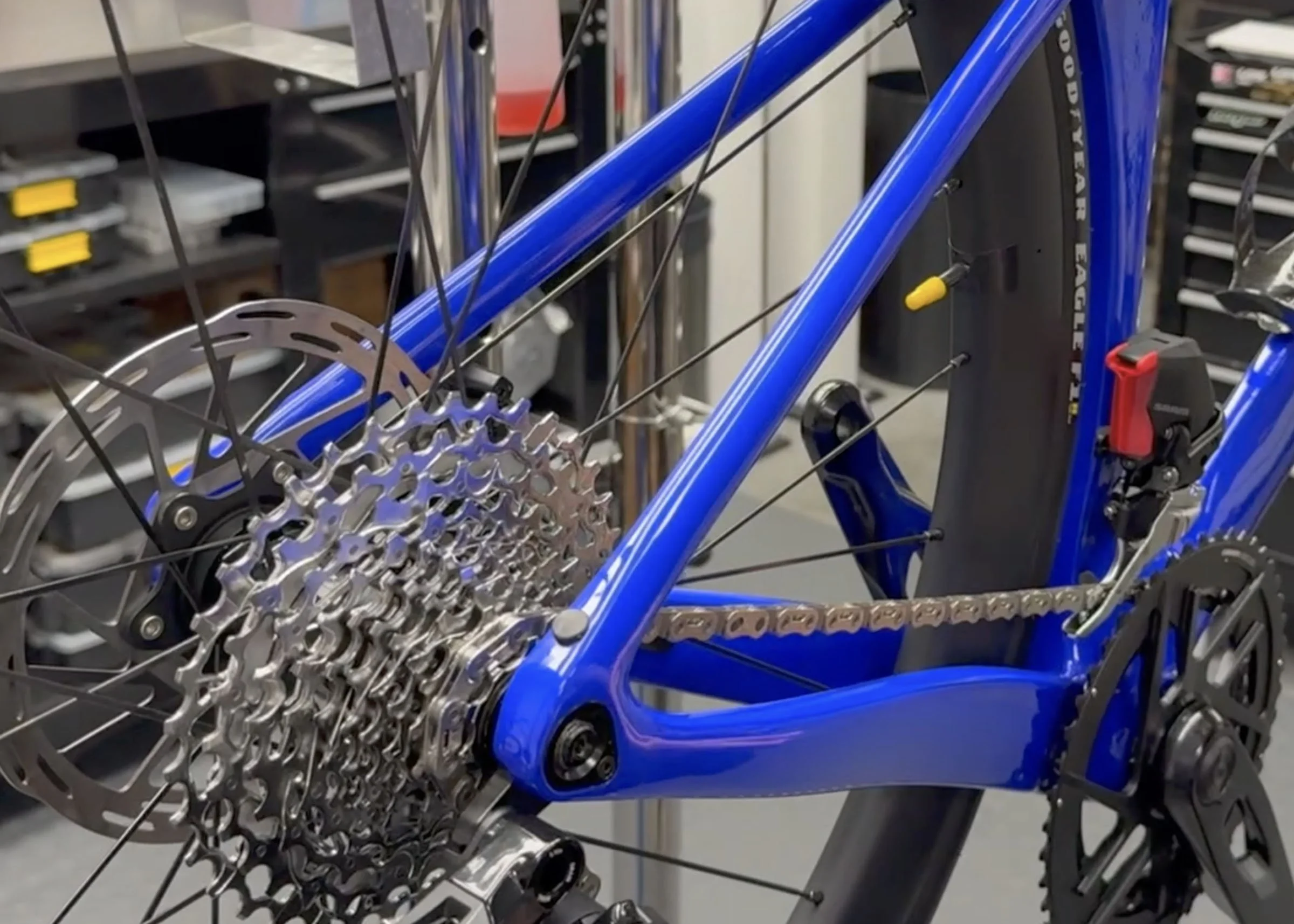
n this configuration the rear derailleur will not shift into the 10T sprocket, making 35 × 11 the hardest available gear
With the bike locked onto the 35T chainring, the rear derailleur behaves differently.
Due to the extreme cross chaining angle, the system will not shift into the 10T sprocket.
Instead it stops at the next sprocket.
The hardest usable gear becomes:
35 × 11
This becomes the maximum available gear in race configuration.
We bench tested this repeatedly to confirm the chain cannot be shifted into a higher gear once the front derailleur battery has been removed.
Measuring the Rollout
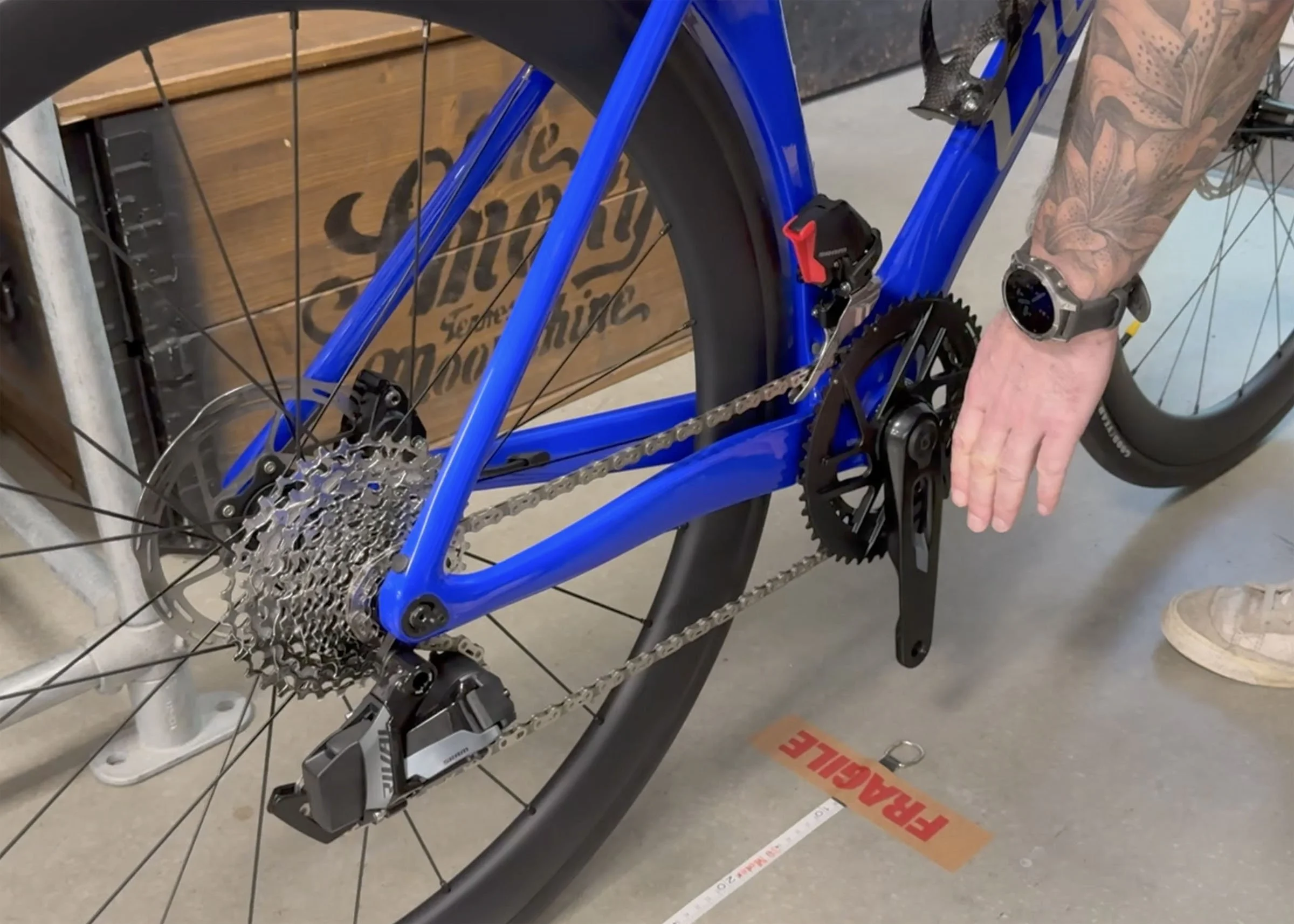
Rollout testing must be performed with the rider on the bike in the hardest available gear
Once the drivetrain configuration was established the rollout test was performed.
The correct method is:
Select the hardest available gear.
Place the crank arm so it’s pointing down perpendicular to the ground over the 0.00m mark.
Lift the front end of the bike and roll it backwards until the crank arm has completed one complete revolution.
Measure the distance travelled.
Rollout Result
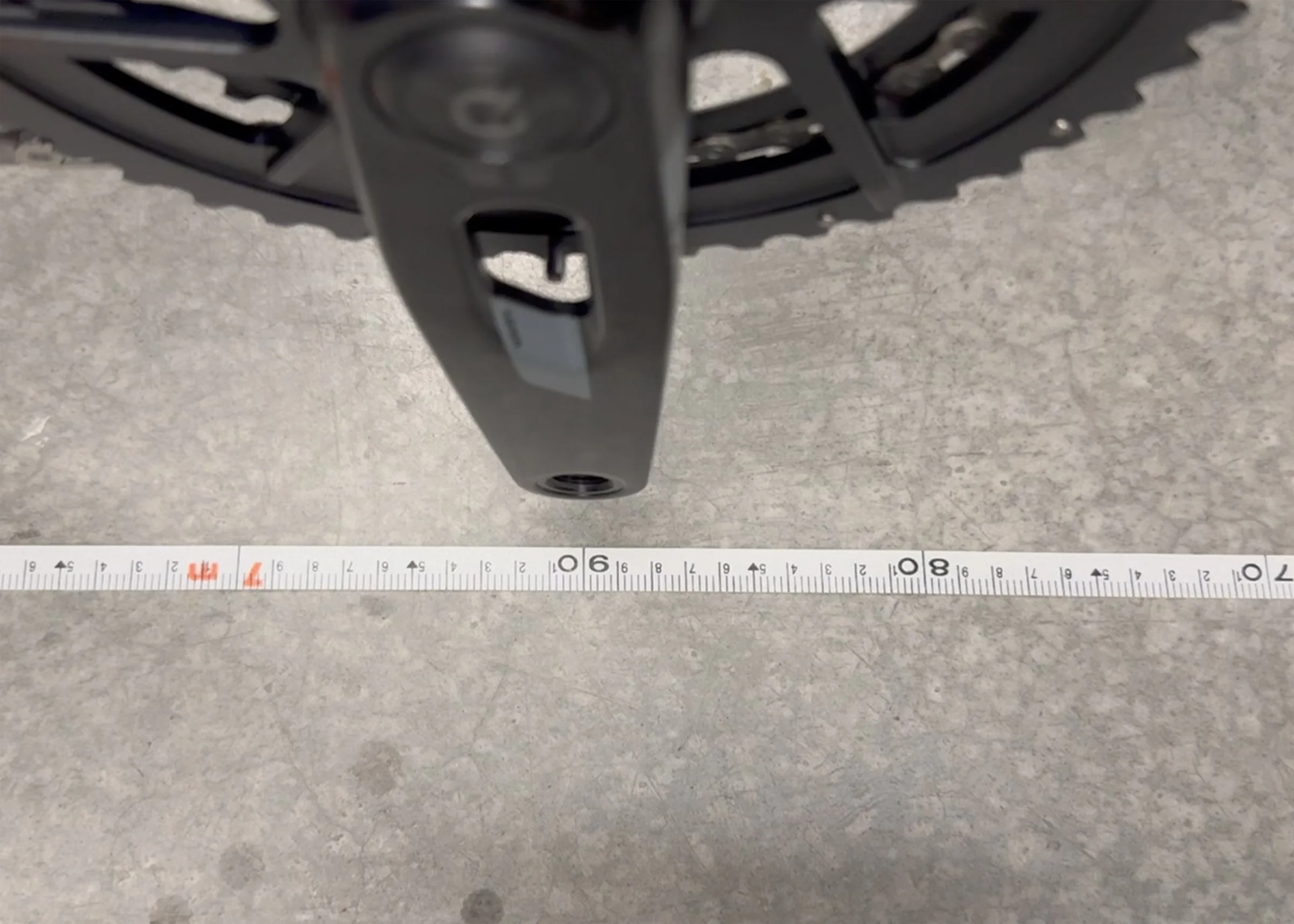
The measured rollout distance came in at 6.90m on this occasion
The test was repeated several times to confirm accuracy. We got 6.87m, 6.89m and 6.90m.
Gear Used: 35 × 11
Measured Rollout: 6.90 metres
Maximum Allowed: 7.00 metres
This places the bike 10cm below the limit.
British Triathlon notes that athletes within 15cm of the maximum rollout remain competitive, meaning this setup sits within the ideal range.
Why Rim Width and Tyre Choice Matter
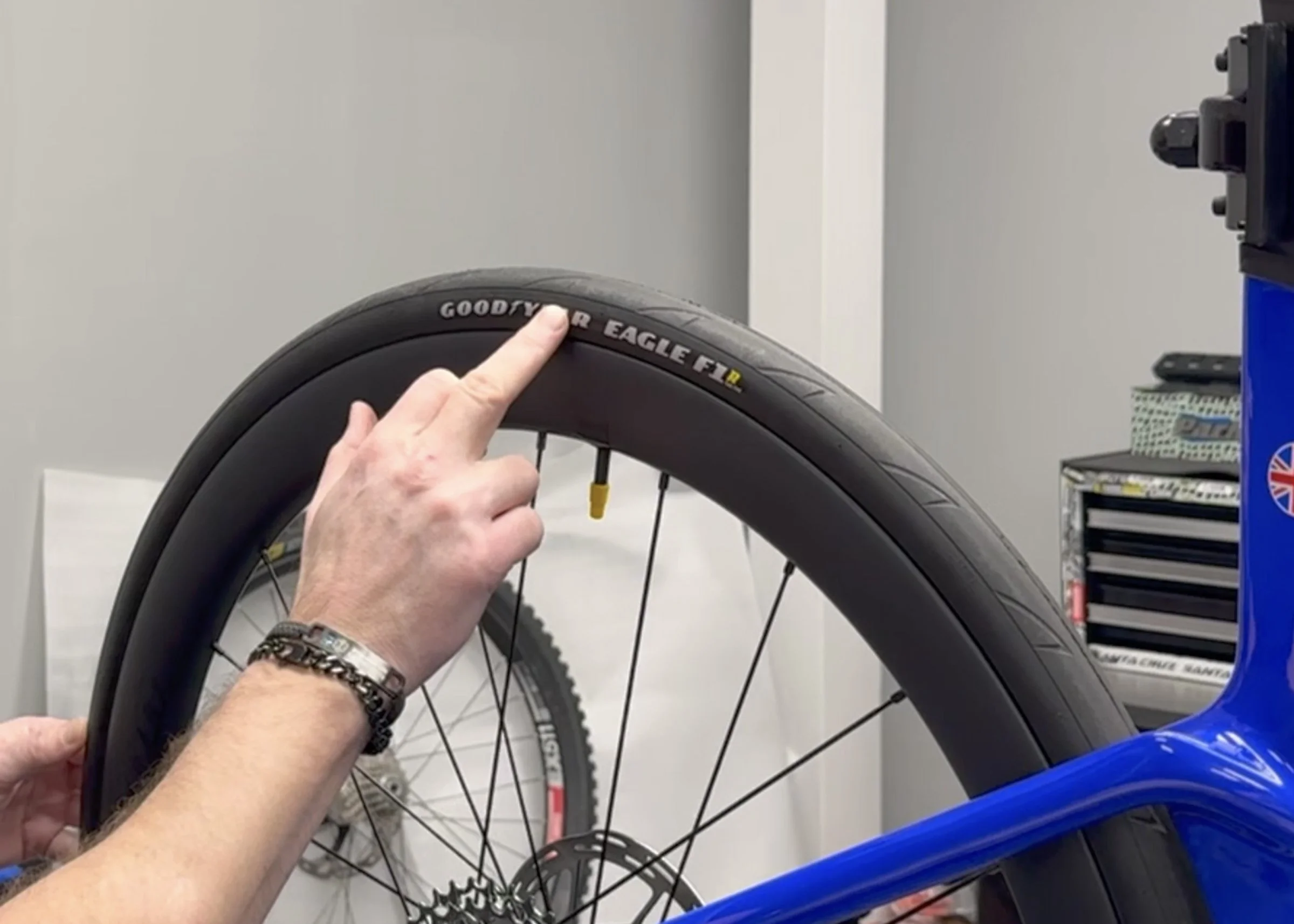
Modern 23mm internal rims and 30mm tyres increase wheel circumference and affect rollout distance
Modern road wheels have significantly wider internal rim widths than older designs.
In this case we chose a wheel internal width of 23mm and tyre width of 30mm. Both increase the effective rolling circumference compared with older narrow setups.
This is one reason British Triathlon adjusted the rollout limit.
It also reinforces why rollout should always be physically measured rather than calculated.
Video Demonstration
We filmed the full process including:
Locking the drivetrain onto the small chainring.
Confirming the cassette cannot access the 10T sprocket.
Measuring the rollout distance.
Common Mistakes When Setting Up Youth Triathlon Gear Restrictions
Several common mistakes often lead to bikes failing rollout checks:
Relying on gearing charts instead of measuring rollout.
Charts cannot account for rim width, tyre shape or tyre pressure.
Restricting electronic derailleurs using limit screws.
This can damage the servo motors inside the derailleur.
Changing tyre pressure after the rollout test.
Pressure changes alter tyre radius and therefore rollout distance.
Rollout Calculation vs Physical Measurement
Rollout can be estimated using the formula:
Rollout = wheel circumference × gear ratio
Gear ratio = chainring teeth ÷ cassette teeth
However, real world factors mean calculated values rarely match measured rollout exactly. Tyre construction, rim width and tyre pressure all affect the final number.
For this reason British Triathlon emphasises physical rollout testing as the only definitive method.
Shimano vs SRAM Gear Architecture
Shimano and SRAM road drivetrains use different cassette architectures. Shimano systems usually use an 11 tooth smallest sprocket. SRAM AXS systems use a 10 tooth smallest sprocket to achieve similar overall gearing with smaller chainrings.
When applying youth gear restrictions, this difference means SRAM setups must sometimes be approached differently to remain within rollout limits.
The method used here solves that problem without restricting the rear derailleur.
Why Bike Setup Still Matters
Modern groupsets continue to evolve, and sometimes regulations lag behind the technology. With careful planning it is still possible to create solutions that are fully compliant, mechanically sensible and easy for athletes to manage.
In this case locking the drivetrain onto the 35T chainring produced a maximum gear of 35 × 11 and a measured rollout of 6.87 - 6.90 metres, safely within the British Triathlon limit.
You can read more about our approach by clicking on the links below.
